

You’ve probably saved a few kitchen layout ideas already.
An island kitchen. An L-shaped layout. Maybe an open-plan design that feels exactly right.
But turning those ideas into something that works in your own home is where uncertainty starts.
Because it’s not just about what looks good. It’s about whether that layout will function properly in your space — day in, day out.
Get it wrong, and you feel it every time you use the room.
After 40+ years designing kitchens across Scotland, the conclusion is simple: the best layout isn’t chosen from inspiration — it’s designed around your space.
This guide breaks down how different kitchen layouts actually perform in real homes, and how to identify what will work in yours.

What Is a Kitchen Layout? (And Why It Matters)
A kitchen layout refers to how the key elements of your kitchen are arranged: from kitchen cabinets and appliances to worktops and the space you move through each day.
It determines how your kitchen functions, not just how it looks.
When a layout is well designed, everything feels intuitive. Movement is reduced, tasks flow naturally between cooking, cleaning and storage, and there is enough worktop space to carry out each task comfortably.
When it isn’t, those same elements work against you. You take extra steps, key areas feel disconnected, and even a visually beautiful kitchen can become frustrating to live with.
TL;DR: How to Choose the Right Kitchen Layout
- There is no single “best” kitchen layout — only what works for your room
- Common kitchen layouts (L-shape, U-shape, galley, island, open-plan) are starting points
- The right layout depends on:
- Room dimensions and proportions
- Fixed features (windows, doors, walls)
- How you use the space daily
- The biggest mistake is forcing a layout you like into a space that doesn’t suit it
- The best results come from tested, measured, and refined kitchen design layouts
Types of Kitchen Layouts (And When They Work Best)
Understanding common kitchen layout types helps, but only when you know where they work in practice.
1. L-Shaped Kitchen Layout: Best for Flexible, Open Spaces
Definition:
An L-shaped kitchen uses two adjoining walls to form an “L” configuration.
Best suited for:
- Open-plan kitchens
- Medium-sized rooms
- Layouts that integrate dining or living areas
Key consideration:
In longer rooms, the layout can stretch too far, reducing the efficiency of movement between key areas and breaking up usable counter space.


2. U-Shaped Kitchen Layout: Best for Efficiency and Storage
Definition:
A U-shaped kitchen uses three connected walls or runs of cabinetry.
Best suited for:
- Dedicated kitchen rooms
- Homes needing maximum worktop and cupboard space.
Key consideration:
Spacing is critical — even small miscalculations can make the layout feel restrictive.
3. Galley Kitchen Layout: Best for Narrow Kitchens
Definition:
A galley kitchen features two parallel runs of units facing each other.
Best suited for:
- Narrow or compact kitchens
- Period homes or extensions
Key consideration:
The width of the walkway determines whether the space feels efficient or cramped.


4. Island Kitchen Layout: Best for Open-Plan Living
Definition:
An island kitchen includes a central freestanding unit within the layout.
Best suited for:
- Larger kitchens
- Open-plan spaces
Key consideration:
Kitchen islands require sufficient clearance — they are often forced into spaces that are too small.
5. Open-Plan Kitchen Layout: Best for Connected Living Spaces
Definition:
An open-plan kitchen layout integrates cooking, dining, and living areas into one space.
Best suited for:
- Modern homes
- Social, family-focused layouts
Key consideration:
Zoning is essential to maintain function and avoid clutter.
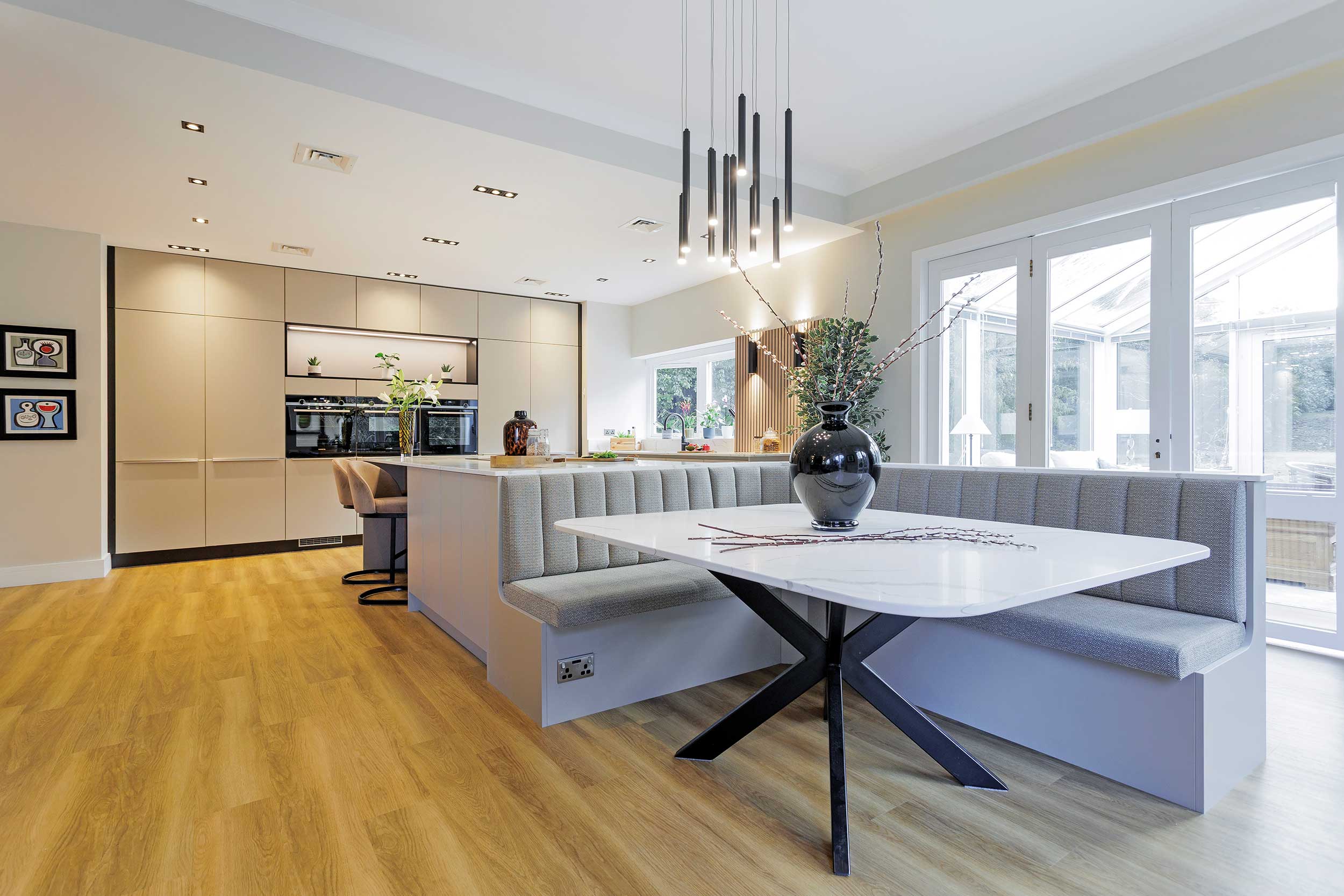
Why Kitchen Layout Ideas Don’t Always Work in Real Homes
Most kitchen layout ideas you see online are designed for ideal conditions.
Real homes are different.
What looks like a clean, simple layout in an image may rely on hidden details, such as integrated corner storage solutions or clever storage solutions, that help keep your kitchen tidy in everyday use, but aren’t immediately obvious.
Common constraints include:
- Fixed window and door positions
- Structural walls that can’t be moved
- Room proportions that limit layout options
For example:
- A slightly off-centre window can disrupt a symmetrical layout
- A doorway can break the flow between key zones
- A room may technically fit an island, but not comfortably

What Actually Determines the Right Kitchen Design Layout
Choosing the right kitchen layout isn’t about preference alone.
It’s about how your space works in practice.
1. Fixed Features and Constraints
Your layout is shaped by:
- Windows
- Doors
- Structural elements
- Plumbing and services
These often dictate what’s possible before design even begins.
2. How You Use Your Kitchen
A good kitchen layout reflects real behaviour.
For example:
- Frequent cooking requires efficient workflow
- Social spaces need open sightlines and seating
- Storage-heavy households need concealed solutions
3. Flow Between Spaces
Your kitchen layout should support movement to:
- Dining areas
- Living spaces
- Outdoor access
This is especially important in open-plan kitchen designs.
4. Room Proportions
It’s not just size — it’s shape.
Two kitchens with the same area can require completely different layouts depending on:
- Width vs length
- Ceiling height
- Light distribution

The Most Common Kitchen Layout Mistake
The most common mistake is trying to force a layout to fit, rather than designing one that fits the space.
It usually starts with a layout chosen from inspiration. From there, small adjustments are made to make it work within the room’s constraints. Over time, those adjustments begin to add up, and functionality is quietly compromised in ways that aren’t always obvious at first.
The result is often a kitchen that feels close to what was intended, but not quite right in how it works day to day.
How Professional Kitchen Layout Design Improves the Outcome
The difference isn’t just experience — it’s the process behind it.
At J.S. Geddes, layout design begins in your home. The space is assessed in person, allowing designers to understand its true dimensions, constraints, and how it’s used day to day. From there, layout ideas are tested against real measurements rather than assumptions, and multiple design options are developed to explore what works best.
These layouts are then drawn and presented clearly, giving you the opportunity to review, question and refine the design before making any commitment.
Final measurements are also personally checked before installation, ensuring a precise fit. This is particularly important when working with precision-engineered German kitchens, where accuracy directly impacts both function and finish.

You’ve Seen the Layout Ideas — Now Find What Works for Your Kitchen
By now, you’ve likely recognised something:
It’s not a lack of ideas that makes kitchen layout decisions difficult.
It’s the uncertainty of how those ideas translate into your space.
That’s the point where most homeowners pause.
- You don’t want to commit too early
- You don’t want to get it wrong
- And you don’t want to look back and wish you’d explored better options
That hesitation is completely normal, and it’s also where the right guidance makes the biggest difference.
Book a Complimentary In-Home Kitchen Design Consultation
If you’d like to understand how your layout ideas translate into your actual space:
- A designer will visit your home and assess the room in detail
- Your existing ideas will be reviewed and tested against real constraints
- Practical layout options will be developed and explained clearly
You’ll see what works — before making any commitment
There’s no pressure to move forward.
More of Our Insights

How to choose the right floor to ceiling kitchen cabinets
In the past, traditional kitchens have typically consisted of base cabinets and wall cabinets with freestanding or integrated appliances.

Open-Plan Kitchen Designs to Elevate Your Home
The concept of an open-plan kitchen isn’t a new one, however, as styles and trends progress, there are countless ways to create a bespoke approach to open-plan…

How to Create Your Dream Luxury Kitchen Design
There’s something deeply personal about a well-designed kitchen. It’s not just where meals are made, but where mornings begin, guests gather, and quiet moments…